Prevent & Treat Bench Press Shoulder Pain in Hillsboro, OR
Bench press is one of the most popular strength-training exercises.
It is also one of the most common lifts associated with shoulder pain.
If benching has started causing pain, pinching, clicking, or weakness, you are not alone.
The good news?
Pain during bench press does not automatically mean you need surgery or that you have a rotator cuff tear.
Why Bench Press Can Irritate the Shoulder
Bench press places significant stress on the:
Shoulder joint
Rotator cuff
Front shoulder structures
Chest and upper arm muscles
For many people, pain develops when training demand exceeds what the shoulder can currently tolerate.
That can happen gradually over time.
Common Reasons Bench Press Causes Shoulder Pain
1. Training Volume Increased Too Fast
A sudden jump in:
Weight
Sets
Reps
Frequency
can overload the shoulder.
This is especially common after returning from time off.
2. Poor Recovery
Heavy pressing combined with:
Poor sleep
Inadequate recovery
Repeated upper-body days
High stress
may reduce the shoulder’s ability to tolerate load.
3. Mobility Limitations
Limited shoulder or upper back mobility can change pressing mechanics and increase stress on sensitive tissues.
4. Rotator Cuff Irritation
The rotator cuff helps stabilize the shoulder during pressing.
When irritated or overloaded, pain may occur during:
Lowering the bar
Pressing upward
Locking out
Reaching overhead afterward
5. Technique Factors
Sometimes factors like:
Grip width
Elbow position
Excessive flare
Unstable shoulder positioning
may contribute to irritation.
Common Bench Press Shoulder Pain Symptoms
People often describe:
Pain in the front of the shoulder
Pain on the side of the shoulder
Pinching sensations
Clicking
Pain lowering the bar
Weakness
Pain after workouts
Discomfort sleeping on that side
Some people also notice that overhead pressing becomes painful.
Does Bench Press Shoulder Pain Mean a Tear?
Not always.
Many painful shoulders involve:
Tendon irritation
Overload
Movement-related pain
Stiffness
without a major tear.
Pain intensity does not always match the severity of tissue damage.
A proper evaluation helps determine what is most likely contributing to symptoms.
Why Rest Alone Often Fails
Many lifters try:
Massage guns
Changing exercises constantly
Symptoms may improve temporarily.
But pain often returns when pressing resumes if underlying issues were never addressed.
The goal is not just to calm pain.
The goal is to improve the shoulder’s ability to tolerate training again.
How Physical Therapy Helps Bench Press Shoulder Pain
At Tualatin Valley Physical Therapy, treatment may include:
Rotator cuff strengthening
Shoulder blade control work
Mobility restoration
Pressing modifications
Upper back strengthening
Training-load guidance
Return-to-lifting progression
Pain-management strategies
Every plan is personalized to your goals and training style.
Advanced Options for Persistent Shoulder Pain
Some lifting-related shoulder pain improves with rehab alone.
Persistent pain may also benefit from advanced conservative options when appropriate.
High-Intensity Laser Therapy (HILT)
Laser therapy may help support pain reduction and recovery while progressing through rehab.
Shockwave Therapy (ESWT)
Some stubborn cases of tendon-related shoulder pain may benefit from shockwave therapy as part of a broader rehab plan.
Why These Work Best With Rehab
Modalities alone are rarely the full answer.
The best outcomes usually occur when combined with:
Strengthening
Mobility work
Movement retraining
Smart load progression
You May Not Need To Stop Training Completely
Many active adults can continue modified training while recovering.
The goal is often to:
Reduce aggravation
Maintain fitness
Rebuild tolerance gradually
Return confidently to pressing
A smart modification plan is often better than complete inactivity.
When To Get Help for Bench Press Shoulder Pain
Consider getting evaluated if:
Pain lasts more than 1-2 weeks
Pressing hurts consistently
Overhead work is painful
Symptoms keep returning
Sleep is affected
You are avoiding exercises
Training quality is dropping
Earlier guidance often makes recovery easier.
Bench Press Shoulder Pain Treatment in Hillsboro, OR
If you are searching for:
Shoulder pain during bench press
Shoulder pain lifting weights
Gym shoulder pain physical therapy
Rotator cuff pain from lifting
Shoulder pain overhead press
Sports Physical Therapy Hillsboro
Tualatin Valley Physical Therapy provides one-on-one personalized care designed to help active adults and lifters return to training with confidence.
Stop Letting Shoulder Pain Disrupt Your Training
You don't need to keep guessing or wait for it to improve on its own.
Get a personalized plan designed to help your shoulder tolerate lifting again.
Book your evaluation today.
Shoulder Pain With Bench Pressing FAQs
-
Shoulder pain during bench press usually occurs when the shoulder is loaded in a position it does not tolerate well.
Common contributors include poor scapular control, excessive elbow flare, limited shoulder or thoracic mobility, rotator cuff weakness, excessive training volume, or returning to heavy pressing too quickly after a flare-up.
-
Not always. In many cases, you do not need to stop all pressing forever, but you may need to temporarily modify the movement. This can include reducing weight, changing grip width, limiting range of motion, using dumbbells, switching to push-ups or landmine presses, or avoiding painful variations while you rebuild strength and control.
Sharp, worsening, or lingering pain is a sign that you should stop that specific variation and get assessed.
-
Sometimes, but not always. Many cases of shoulder pain with bench press are related to irritation, overload, poor mechanics, or reduced capacity rather than a full tear.
However, if you have significant weakness, nighttime pain, loss of range of motion, pain after a specific injury, or difficulty lifting your arm, it is worth getting evaluated by a healthcare professional.
-
Common bench press mistakes that can irritate the shoulder include:
Elbows flaring too far out to the side
Shoulders rolling forward at the bottom of the lift
Poor shoulder blade positioning
Grip that is too wide
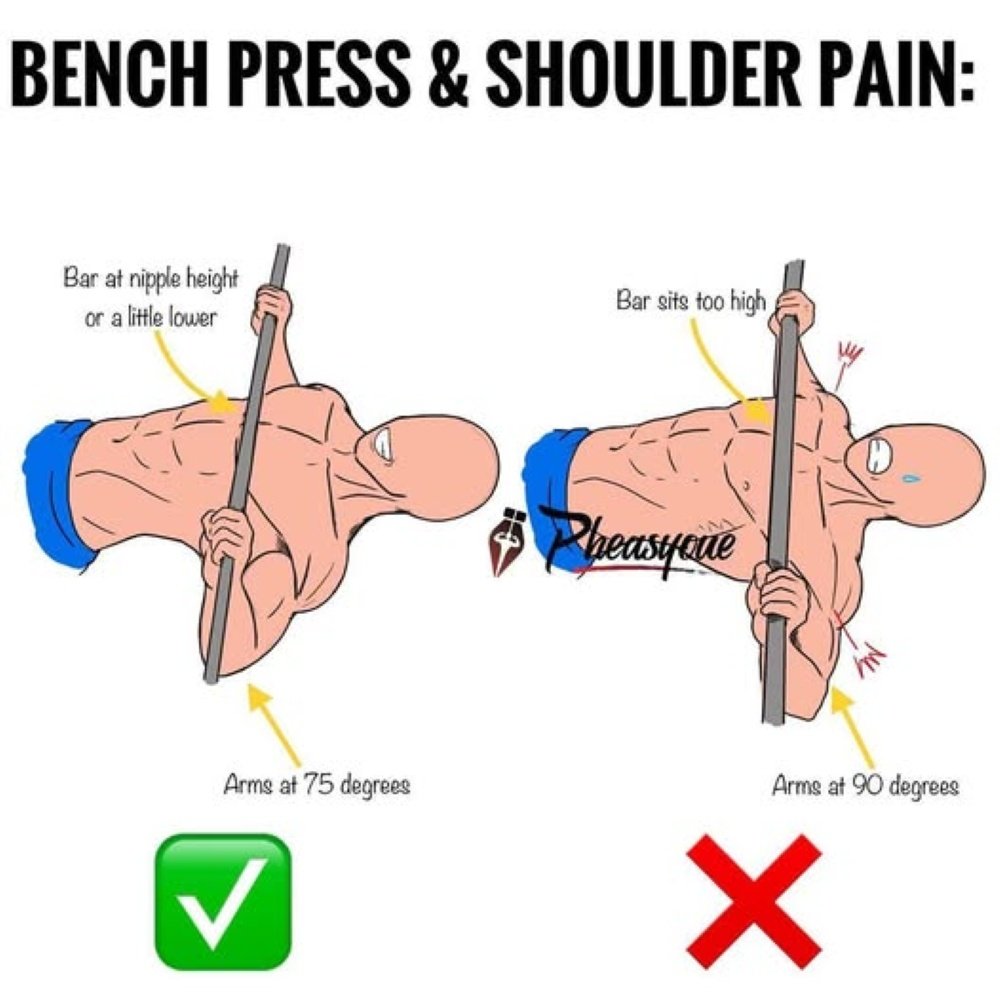
Lowering the bar too high on the chest
Progressing weight or volume too quickly
Small technique changes can make a major difference in shoulder comfort.
-
Most lifters do better with the elbows angled slightly down from the shoulders rather than flared straight out at 90 degrees.
A moderate tuck, often around 30–60 degrees depending on body type and grip width, can reduce shoulder stress while still allowing strong pressing mechanics.
-
Absolutely! The shoulder blade plays a major role in pressing strength and shoulder health. If the scapular muscles are not effectively controlling the shoulder blade, the shoulder joint may take on extra stress during the bench press.
Strengthening the upper back, lower traps, serratus anterior, and rotator cuff can help improve shoulder mechanics.
-
Helpful exercises often include:
Band external rotations
Face pulls
Serratus punches
Scapular push-ups
Chest-supported rows
Landmine presses
Controlled push-up progressions
Rotator cuff and upper back strengthening
The best exercises depend on the cause of your shoulder pain, so a personalized plan is ideal if the pain keeps returning.
-
For some people, yes. Dumbbells allow a more natural arm path and can reduce stress on the arms compared to a straight barbell. A neutral-grip dumbbell press may be especially helpful because it allows the shoulder to stay in a more comfortable position.
However, dumbbells can still irritate the shoulder if the load, depth, or control is not appropriate.
-
Usually, yes, but you may need to adjust your exercise selection. Pain-free options may include push-ups, machine chest press, cable press variations, landmine presses, or partial-range pressing.
The goal is to maintain training while reducing irritation and rebuilding shoulder capacity.
-
You should consider seeing a physical therapist if:
Shoulder pain lasts longer than 1–2 weeks
Pain returns every time you bench press
You feel weakness or instability
Pain affects sleep or daily activities
You cannot progress training without flare-ups
You are unsure whether your form, mobility, or strength is the issue
A physical therapist can assess your shoulder, pressing mechanics, strength, mobility, and training load to build a clear return-to-bench plan.
-
Long-term prevention usually requires more than rest. Focus on:
Gradual progression of weight and volume
Strong rotator cuff and upper back muscles
Good shoulder blade control
Appropriate grip width and elbow position
Adequate recovery between pressing sessions
Balanced pulling and pressing volume
Pain relief is only step one. The real goal is building a shoulder that can tolerate pressing again.
-
Bench press is not inherently bad for your shoulders. For many people, it is a safe and effective strength exercise when properly programmed and performed. Problems usually arise when the load exceeds capacity, the technique breaks down, mobility is limited, or recovery is poor.
With the right approach, many lifters can return to bench pressing comfortably.