Calisthenics vs. Weights: What Your Body Actually Needs
You’re Asking the Wrong Question
“Should I be doing calisthenics or lifting weights?”
It’s one of the most common questions I hear.
And the honest answer?
You’re asking the wrong question.
Because this isn’t about choosing sides.
It’s about understanding what your body actually needs to move well, stay pain-free, and perform at a high level.
From the perspective of a Doctor of Physical Therapy, the goal isn’t just getting stronger.
It’s building a body that:
Moves efficiently
Handles stress without breaking down
Performs consistently without pain
And that requires more than just one style of training.
What Most People Get Wrong About Training
Most people think:
Calisthenics = functional
Weights = bulky strength
But that’s an oversimplification.
Both are just tools.
And like any tool, their value depends on how you use them.
The real difference comes down to this:
What type of strength are you building?
Calisthenics: Mastering Your Body
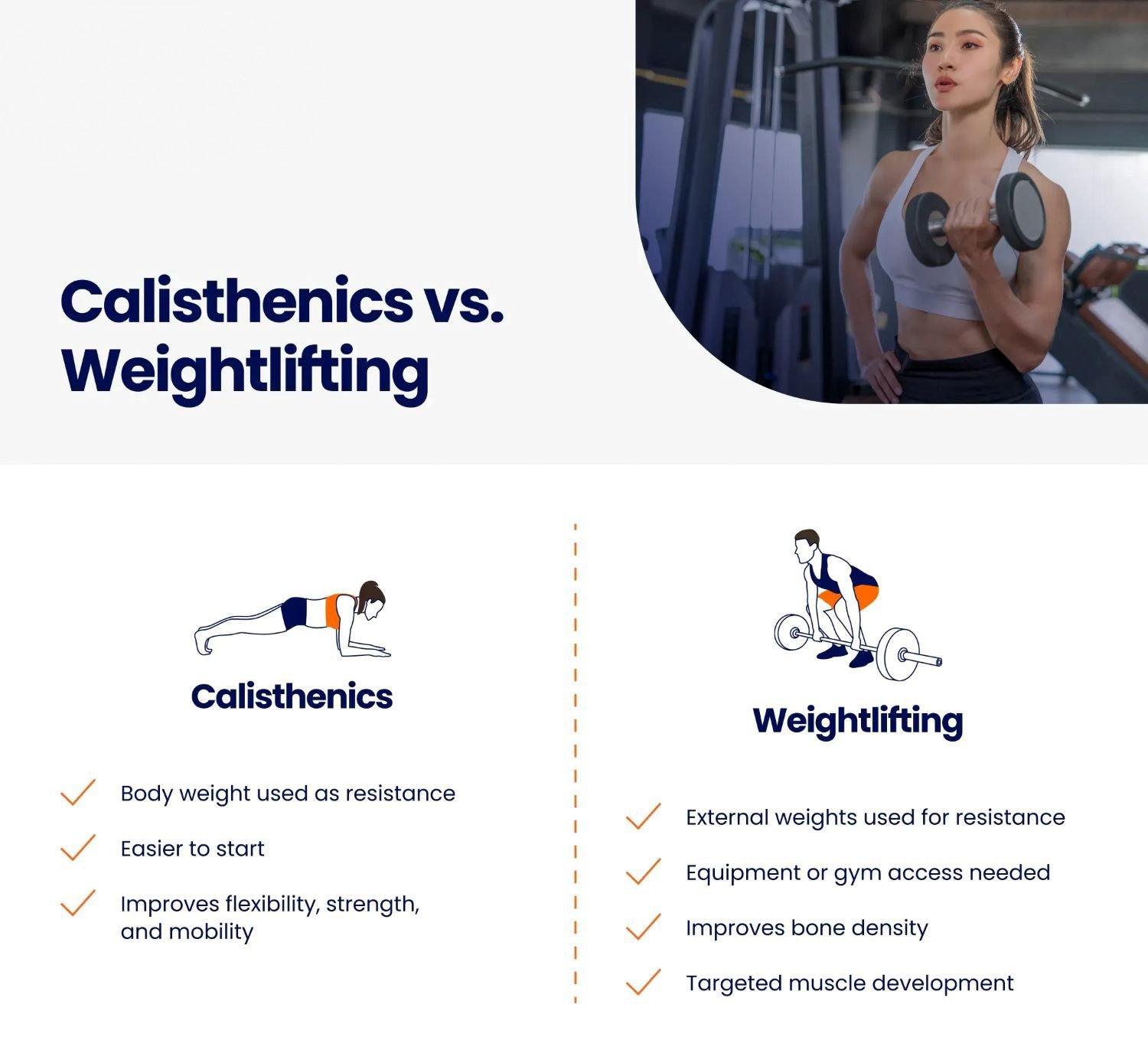
Calisthenics uses your body weight as resistance.
Think:
Push-ups
Pull-ups
Lunges
Squats
What it does really well
Calisthenics builds:
✔ Body control
✔ Coordination
✔ Balance
✔ Relative strength (how strong you are for your size)
It teaches your body to move as a unit, not as isolated parts.
That’s why it’s incredibly valuable for:
Athletes
Runners
Injury prevention
Early rehab phases
Where it falls short
It can be harder to:
Progress precisely
Build maximal strength
Target specific muscle groups
At some point, your body adapts, and you need more stimulus.
Weight Training: Building Capacity
Weight training adds external resistance.
Think:
Dumbbells
Barbells
Machines
Kettlebells
What it does really well
Weight training builds:
✔ Absolute strength (how much force you can produce)
✔ Muscle mass
✔ Bone density
✔ Tissue resilience
This is HUGE for:
Long-term durability
Performance under load
Where it falls short
If done poorly, it can:
Reinforce bad movement patterns
Increase injury risk
Ignore coordination and control
Strength without control doesn’t translate well to real life.
The Real Difference: Relative vs Absolute Strength
Here’s the simplest way to understand it:
Calisthenics = Relative Strength
Weight Training = Absolute Strength
Both matter.
Relative strength helps you move efficiently
Absolute strength helps you handle higher demands
If you only train one…
You leave a gap.
What Actually Matters (From a DPT Perspective)
I don’t care whether you’re doing pull-ups or deadlifts.
I care about this:
Can your body handle what you’re asking it to do?
Because most injuries happen when there’s a mismatch between:
Load vs Capacity
Too much load → breakdown
Not enough load → weakness
The goal is to build a system that can adapt.
That means:
✔ Strength
✔ Control
✔ Mobility
✔ Stability
Not just one of them.
So Which One Should You Do?
It depends on your goal(s).
Calisthenics may be better if you want:
Better body control
Improved mobility
Functional movement
Minimal equipment
Weight training may be better if you want:
More muscle
More strength
Injury resilience
Performance gains
But for most people…
The best answer is BOTH.
The Best Approach: Combine Them
This is where things click.
Use:
Weights to build strength and capacity
Calisthenics to refine movement and control
This combination gives you:
✔ Strength + coordination
✔ Power + efficiency
✔ Stability + mobility
This is how you build a body that actually performs.
Common Mistakes That Lead to Injury
This is where I see people get into trouble:
❌ Only lifting heavy without control
❌ Only doing bodyweight work without progression
❌ Ignoring mobility and stability
❌ Chasing workouts instead of results
And the biggest one:
❌ Training without a plan
How to Train Smarter (Not Just Harder)
If you want long-term results, focus on:
1. Movement quality first
If it doesn’t look good, it won’t feel good long-term.
2. Progress gradually
More isn’t better. Better is better.
3. Train through full ranges of motion
This builds real strength, not just partial strength.
4. Balance strength with control
Strong + sloppy = injury risk
When to Get Help
If you’re dealing with:
Recurring pain
Plateaus in performance
Movement limitations
Injuries that “keep coming back”
That’s usually not a workout problem.
That’s a strategy problem.
And that’s where a Doctor of Physical Therapy can help.
The Takeaway
Calisthenics vs weight training isn’t a competition.
It’s a collaboration.
One builds control
One builds capacity
And together, they build a body that:
✔ Moves better
✔ Feels better
✔ Performs better
Ready to Train Smarter?
At Tualatin Valley Physical Therapy, we help active adults and athletes:
✔ Fix movement issues
✔ Build strength the right way
✔ Stay pain-free long-term
Schedule your free 15-minute consultation or same-day visit today.
Because you shouldn’t have to guess your way through your training.